The Obscurity of Commemoration
“There’s no better way of forgetting something than by commemorating it.”
– Alan Bennett, The History Boys[1]
When the torch of white supremacy scorned the streets of Charlottesville, Virginia, America was forced to confront its undying capacity for violence in the 21st century, a form of violent domination whose genesis can be traced back to 1619. Black Americans attempted to defend their history and dignity by demanding the de-commemoration of yet another monument to white violence. Commemoration attempts to remember and honor historical periods; however, routinely, the stories and people who are honored are white. Commemoration requires remembrance, and yet, frequently, the memory invoked obscures the necessary nuance of history. When we ask white people to remember slavery, we ask them to recall an experience they have never had and have deliberately obscured themselves to. Yet, despite many commemorations of slavery like Juneteenth, lynching memorials, and civil rights memorials, this form of remembrance has not brought about recognition or requital on behalf of the distress of black life. Absent the political and social recognition of the state; black people can never be granted true relief from their oppression. In his play The History Boys, Alan Bennett argues commemoration is a process of forgetting. To commemorate something renders it a relic of the past. Slavery never ended; it is an ongoing process of white domination and an economic strategy assumed by the entirety of the state. Commemoration regards slavery, an enduring institution of the present, as one merely of the past. To truly honor the plight of the Black Atlantic, we must extend our demands beyond nominal remembrance and require the formal political recognition and restitution of the state.
Commemoration’s purport and aspire to honor the dead, yet in the context of the Black Atlantic, its effects perpetually obscure crucial substance in the narrative of slavery. Nuance in historical accounts of slavery is imperative to honor the black experience; it is the difference between regarding Juneteenth as a true mark of emancipation while 250,000 slaves remained enslaved, or truly confronting how the afterlives of slavery prevail in the American consciousness and poison political action.[2]
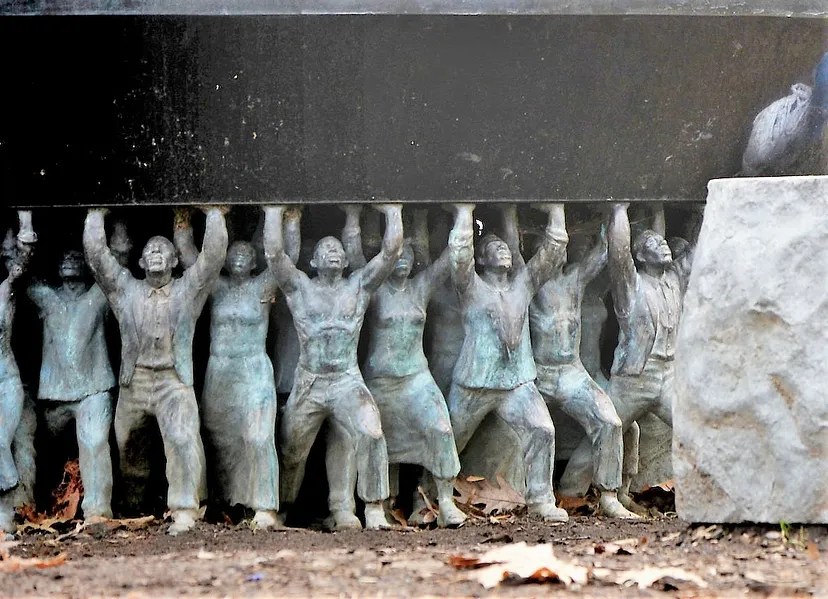
The Unsung Founders Memorial, located on the University of North Carolina campus, claims to honor “the unsung founders — the people of color bond and free — who helped build the Carolina that we cherish today” (Alexia 2018)[3]. The sculpture, created by artist Do-Ho Suh, depicts 300-bronze men holding up a stone table. The art was donated to the university in 2005 by the class of 2002; both students and the artist requested the piece be displayed in a prominent location on campus. However, the university opted to use this artistic commemoration in a scheme to justify their continued veneration of white slave owners. In hopes of “quell[ing]controversy” surrounding their refusal to get rid of a confederate statue on campus, Silent Sam, the university placed the table in the same area as a monument to white violence (Alexia 2018). Furthermore, when students stood in defense of the black experience and called for the de-commemoration of Silent Sam, the university proposed donating the piece to a white nationalist organization, not a museum. Years later, in 2019, UNC would feel the ramifications of their refusal to confront white racial bias on campus when white students defaced the memorial with racial slurs and urine. In an attempt to glorify both white domination and black contributions coordinately, UNC missed a pivotal opportunity to educate its students and instead embraced “the contorted logic that it is possible to separate the Confederacy from the institution of slavery, that it’s a whites-only story and slavery is blacks-only, and that treason is the same as patriotism” (Richardson 2017)[4]. Ultimately, the university appropriated the statue as a contrivance to excuse itself for its connections to the Confederacy. UNC’s endeavor to revere white violence and black life synchronously reflects a begrudged refusal to rid themselves of an obstinate brand of southern pride, “not an ignorant but a defiant one. It is a pride that says, our history is rich, our causes are justified, our ancestors lie beyond reproach. It is pining for greatness, if you will, a wish again for a certain kind of American memory. A monument-worthy memory” (Williams 2020)[5]. Author Judith Carney in Woman’s Wuk- The African Origins of Rice Cultivation in The Americas explains the strength of the Carolina’s slave economy can be primarily accredited to the knowledge systems passed down by women from West African tradition; yet the memorial only depicts men.[6] This is but a minute example of the scale to which the reduction of slave narratives to plaques and statues suppresses necessary aspects of history. The inanimate cannot restore living to the dead.
The history of the American rise to hegemony reflects one core principle: white freedom has invariably meant black oppression. Juneteenth is celebrated as Emancipation Day, reflecting the precise sort of contradiction on which the American consciousness is forged. On the same day as this delusive proclamation, thousands remained in slavery, others remained captive in indentured servitude, and slavery would prove to be reinvented ad nauseam in American institutions centuries later.[7] America is content to engage in this commemoration whilst profiting from and securing the afterlives of slavery. In Fredrick Douglass’s address to the nation on the Fourth of July, he proclaims, “America is false to the past, false to the present and solemnly blinds herself to be false to the future” (Douglass 1852). Americans regard liberty as a foundational principle from which they could never deviate rather than acknowledging their relentless historical strategy of oppression. By internally cultivating division and demarcating some as the backs for our “great” leaders to mount and globally broadcast standards of justice they never intended to uphold and, in fact, crushed beneath their stance; America is able to maintain a veil of justice in the frame of the cracked and bloodstained mirror of history. Commemoration acts with an eye to the past; however, Douglass cautions, “trust no future, however pleasant, let the dead past bury its dead; act, act in the living present, heart within, and God overhead” (Douglass 1852). When we mark a false holiday, we allow whites to celebrate the perseverance of American ideals over the “poisonous” practices of the south and legitimize their claim that justice has triumphed over racism.[8] Professor of African American studies Shane-Bolles Walsh explains, “if you want to commemorate something, you literally have to buy land to commemorate it on,” representing a “potent example of the long-lasting reality of white supremacy” (Young 2021). When we erect statues on stolen land, we engage in an economic system built on black suffering and ask it to alter an outcome it has been mechanically engineered to produce. Commemoration refutes the idea that slavery lives on; it allows white people to preemptively move up the finish line in the race for justice while simultaneously pushing that line further away from the bleeding feet of the black body. To act in the living present, we must regard the fickle future not as a period of predetermined progression due to the false narrative trajectory of white history, but as an objective attainable through the revolutionary action of the living.
Commemorate- to call to remembrance[9]
When we attempt to honor Black Life through inanimate statues and holidays celebrated by a government that since its genesis has produced and re-produced the oppression of black bodies, we further obscure the realities of slavery and its afterlives. We must regard racism as fundamentally intertwined with property and capitalism. In his essay “American Capitalism is Brutal,” Matthew Desmond informs us “we cannot simply regard slavery or its afterlives as symptoms of “dumb racism,” nullified by a mere “celebration” of black contributions; “the violence was neither arbitrary nor gracious. It was rational, capitalistic, all part of the plantation’s design” (Desmond 2019)[10]. UNC attempted to separate ideology from practice by venerating Silent Sam and extending a polite nod to the black people who built this nation. This is not a fluke in the American value system; it is in this contradiction where racial violence has always flourished. In “The Case for Reparations” Ta-Nehisi Coates argues, “to celebrate freedom and democracy while forgetting America’s origins in a slavery economy is patriotism à la carte” (Coates 2014)[11]. To account for this level of entrenchment, we must require more of white people than a mere “remembrance” of a history they have already forgotten. We must demand they acknowledge the afterlives of slavery and seek to rectify these lasting instances of oppression, regardless of the threat it poses to white comfort.
Remembrance- a store of personal experiences available to recollection (French 1300)[12]
Recognition– an acknowledgment of something’s existence, validity, or legality[13]
Recognition- formal acknowledgment of the political existence of a government or nation
When we ask white people to remember slavery through a form of commemoration, we ask them to perform a task they are incapable of. Unlike black people, they have no store of anecdotal experience to recall the violence of slavery or its afterlives. They have no grandparents to tell them stories of marching in the ’60s and suffering from police violence, no one whose wounds they can touch. They cannot instantiate slavery. We must require they recognize the plight of the black experience in the past and present as a valid and legitimate criticism of the capitalistic system. Coates claims “the essence of American racism is disrespect” (Coates 2014). When whites are permitted to merely commemorate and “remember” centuries of unrelenting violence, they feel satisfied in their impact and do nothing to rectify the realities of the present. Demanding respect in the present requires the social and political recognition of black life and black suffering. In Rights, Race, and Recognition[14], Derrick Darby explains, “there are no rights that exist prior to and independent of some form of formal or informal social recognition of a way of acting and being treated by a community of persons” (Darby 2009). In the U.S, black people have been granted rights before recognition. Without the true recognizance of the nature of slavery, its economic system has prevailed. For this reason, our rights have yet to be realized; black death remains a spectacle from which American life appears to have no escape. Recognition can be an act of comprehending a concept or identifying some object; more precisely, political recognition is the act of acknowledging and respecting another human being. This sort of recognition “is an integral component of any satisfactory modern theory of justice as well as the means by which both historical and contemporary political struggles can be understood and justified” (McQueen 2016)[15]. Recognition requires a radical deconstruction of the societal conscious. This sort of adjustment is more than a call for white sympathy which the remembrance of commemoration espouses, “though the white liberal imagination likes to feel temporarily bad about black suffering, there really is no mode of empathy that can replicate the daily strain of knowing that as a black person, you can be killed for simply being black” (Rankine 2015)[16]. This mode of progress does not simply alter how blacks are valued relative to the rest of society; it reevaluates the normalized premise of prescribing different valuations to human beings based on the color of their skin. The social and political recognition of black life would comprehensively reform society, whereas commemoration nullifies the need for this reform in the mind of white people. Commemoration says two things: slavery is of the past, and we live in the future. Neither of which is true; slavery will live on until we acknowledge its past and present realities.
In the present, we must “refuse the forgetting” and elucidate slavery’s enduring lifespan. Christina Sharpe recommends that in the afterlives of slavery, we must engage in “wake work,” an attempt to defend the dead and restore dignity to the living, ultimately a call for recognition.[17] She explains, through the black annotation and redaction of history, a method of “adding notes” and revising accounts of black life and death, we can center black people at the heart of their history and as the leaders in defining the present. Claudia Rankine argues, commemorations that catalog black death serve to repeat “the visual, discursive, state and other quotidian and extraordinary cruel and unusual violence enacted on Black people [it] does not lead to a cessation of violence, nor does it, across or within communities, lead primarily to sympathy or something like empathy. Such repetitions often work to solidify and make continuous the colonial project of violence” (Rankine 2015)[18]. The Black Lives Matter organization is an example of a group that refuses forgetting; they bring mourning into the present and regard it as provocative political action. They refuse to require we merely remember the victims, they demand reforms to a racist system of policing; “if the Rev. Martin Luther King Jr.’s civil rights movement made demands that altered the course of American lives and backed up those demands with the willingness to give up your life in service of your civil rights, with Black Lives Matter, a more internalized change is being asked for: recognition” (Rankine 2015). In the face of falsified police autopsies, the families of slain black men and women may request a second autopsy; this is a form of annotation, an interjection in the desired narrative of white oppressive forces. The initial police autopsy reported George Floyd could have died from intoxicants or heart disease, yet when the family ordered a second autopsy, it proved his death was due to asphyxiation at the hands of the police. This form of annotation requires white people confront the realities of their violence.
The accomplishment of, at minimum, white social recognition of the plight of black life and the value of black bodies would mark a national attempt to mend the psychic injury years of neglect have produced. This, however, is only a preliminary step towards radical societal and governmental change. The redistribution of wealth and power is necessary to alter the injustice born of institutionalized discrimination; societal recognition merely allows society to rehearse the kind of accountability required to pay the economic price of equality. This form of genuine recognition cannot come from mere remembrance of an institution of the past; we must recognize the prolonged suffering of black bodies and extend to them legal legitimacy. Reparations mark a method of legitimizing black struggle at the hands of a tyrannical government. Regarding the unfinished and unpaved pathway to emancipation, we are hearing the starting shotgun. Our first hurdle is recognizing the calamity of slavery, then actually taking issue with it; commemoration cannot produce this form of recognition. Headstones and plaques mark graves and memoriums; until slavery has truly died, we cannot bury it.
Works Cited
1. Bennett, Alan. The History Boys. Cross Academe Ltd, 2017.
2. Sharon Pruitt-Young, “Slavery Didn’t End on Juneteenth. What You Should Know about This Important Day,” NPR (NPR, June 17, 2021)
3. Lilly Alexia, “The Unsung Founders Monument, University of North Carolina,” Clio, 2018
4. Lisa Richardson, “Op-Ed: I’m a Black Daughter of the Confederacy, and This Is How We Should Deal with All Those General LeesL,” Los Angeles Times (Los Angeles Times, August 27, 2017)
5. Caroline Randall Williams, “You Want a Confederate Monument? My Body Is a Confederate Monument,” The New York Times (The New York Times, June 26, 2020),
6. Carney, Judith Ann. Black Rice: The African Origins of Rice Cultivation In the Americas. Cambridge, Mass.: Harvard University Press, 2001
7. Sharon Pruitt-Young, “Slavery Didn’t End on Juneteenth. What You Should Know about This Important Day,” NPR (NPR, June 17, 2021),
8. Fredrick Douglass, “‘What to the Slave Is the Fourth of July| The National Constitution Center, July 4, 1852,
9. “Commemorate Definition & Meaning,” Merriam-Webster (Merriam-Webster), accessed December 2021
10. Ta-Nehisi Coates, “The Case for Reparations,” The Atlantic (Atlantic Media Company, May 14, 2014), https://www.theatlantic.com/magazine/archive/2014/06/the-case-for-reparations/361631/.
11. “Commemorate Definition & Meaning,” Merriam-Webster (Merriam-Webster), accessed December 2021
12. “Remembrance (N.),” Etymology, accessed December 2021, https://www.etymonline.com/word/remembrance.
13. “Recognition Definition & Meaning,” Merriam-Webster (Merriam-Webster), accessed December 2021, https://www.merriam-webster.com/dictionary/recognition.
14. Matthew Desmond, “American Capitalism Is Brutal. You Can Trace That to the Plantation.,” The New York Times (The New York Times, August 14, 2019),.
15. Sharpe, Christina. In the Wake on Blackness and Being. Durham, N.C: Duke University Press, 2016.
16. Rankine, Claudia. “‘The Condition of Black Life Is One of Mourning’.” The New York Times. The New York Times, June 22, 2015.
1. Bennett, Alan. The History Boys. Cross Academe Ltd, 2017.
2. Sharon Pruitt-Young, “Slavery Didn’t End on Juneteenth. What You Should Know about This Important Day,” NPR (NPR, June 17, 2021)
3. Lilly Alexia , “The Unsung Founders Monument, University of North Carolina,” Clio, 2018
4. Lisa Richardson , “Op-Ed: I’m a Black Daughter of the Confederacy, and This Is How We Should Deal with All Those General LeesL,” Los Angeles Times (Los Angeles Times, August 27, 2017)
5. Caroline Randall Williams, “You Want a Confederate Monument? My Body Is a Confederate Monument,” The New York Times (The New York Times, June 26, 2020),
6. Carney, Judith Ann. Black Rice: The African Origins of Rice Cultivation In the Americas. Cambridge, Mass.: Harvard University Press, 2001
7. Sharon Pruitt-Young, “Slavery Didn’t End on Juneteenth. What You Should Know about This Important Day,” NPR (NPR, June 17, 2021),
8. Fredrick Douglass, “‘What to the Slave Is the Fourth of July| The National Constitution Center, July 4, 1852,
9. “Commemorate Definition & Meaning,” Merriam-Webster (Merriam-Webster), accessed December 2021
10. Matthew Desmond, “American Capitalism Is Brutal. You Can Trace That to the Plantation.,” The New York Times (The New York Times, August 14, 2019),.
11. Ta-Nehisi Coates, “The Case for Reparations,” The Atlantic (Atlantic Media Company, May 14, 2014)
12. “Remembrance (N.),” Etymology, accessed December 2021, https://www.etymonline.com/word/remembrance.
13. “Recognition Definition & Meaning,” Merriam-Webster (Merriam-Webster), accessed December 2021, https://www.merriam-webster.com/dictionary/recognition.
14. Derrick Darby, Rights, Race, and Recognition (Cambridge, UK: Cambridge University Press, 2009).
15. Paddy McQueen, “Social and Political Recognition,” Internet encyclopedia of philosophy, accessed December 15, 2021,
16. Rankine, Claudia. “‘The Condition of Black Life Is One of Mourning’.” The New York Times. The New York Times, June 22, 2015.
17. Sharpe, Christina. In the Wake on Blackness and Being. Durham, N.C: Duke University Press, 2016.
18. Rankine, Claudia. “‘The Condition of Black Life Is One of Mourning’.” The New York Times. The New York Times, June 22, 2015.
 Payton Selby